Monday, 2 October 2023

Using cognitive mapping to study a video on homelessness: example 2

Using cognitive mapping to study a video on homelessness: example 2


The example is "Homeless Crisis on the Streets of California"


I have constructed the following cognitive map to depict the homeless crisis case as presented in the video.


The cognitive map comprises 4 groups of items. They are:

Group A: The subject under study 

Item 8: go through the homeless experience

Item 9: Homelessness as a serious public issue

Group B: Directly contributive factors [which are inter-related]

Item 1: Poor mental health

Item 2: Drug addiction

Item 3: Low housing affordability

Item 4: Low-income of people

Item 5: Being an ex-prisoner

Item 6: Aging people

Item 7: Disadvantageous ethnic groups


Group C: Types of government support to address homelessness

Item 10: Local government support: medical care

Item 11: Local government support: rental subsidy

Item 12: Local government support: build low-income/ affordable housing


Group D: Environmental constraint

Item 13: Restrictive housing & zoning regulation 


A related reading: example 1 on cognitive mapping.

Sunday, 1 October 2023

Some concept clarification for doing Research Methods (Housing Studies) assignments 2023

Some concept clarification for doing Research Methods (Housing Studies) assignment, 2023


1. On housing affordability (pdf) article.

2. On homelessness. Also study the true scale of homelessness.

3. On home ownership (types).

Using cognitive map to study a video on a homeless case study: an example

Using cognitive map to study a video on a homeless case study: an example


This video is "The difficult life of a Japanese homeless girl"


The following cognitive map is drawn to capture the main drivers and attributes of the homeless experience in this video case study:


There are three groups of items in the cognitive map:
Group 1: Drivers of homelessness
1. Unaffordable level of rental in Tokyo
2. Poor rural parents with limited support to offer
3. Family burden to pay for the girl's education school fee
4. The university degree gained not contribute to the girl's employability
5. Ashamed of seeking further support from parents
6. Experience poverty

Group 2: the topic under review
7. Go through homeless experience [on the street in Tokyo] 

Group 3: a set of related attributes of the homeless experience of a young girl in Tokyo.
8. Hardship from poor weather, e.g. rain
9. Not enough food to eat (a risk)
10. Sleep on the street
11. Availability of store shelter (sometimes)
12. Risk of harassment, especially toward young girls
13. Compete to collect empty bottles to earn some cash
14. Work for unstable part-time jobs 


It is useful for the researcher to also work on (i) the direct personal outcomes of the experienced homeless condition, which could be related to physical, and mental health, career prospect and employability, social networking and personal financial status and prospect, etc. and (ii) broader societal impacts.

Using the sociological imagination method, a researcher could work on transforming the personal issue of an individual (e.g. a single case of a homeless girl) into a public issue (in the form of a cognitive map). To do the imaginative leap (re: sociological imagination) from an individual issue to a public issue, the researcher needs to conduct additional exploratory investigation (e.g. desk research) so as carry out an informed imaginative leap.


A related reading: Example 2 on cognitive mapping.

Friday, 29 September 2023

Cognitive mapping exercise to explore "the effect of covid-19 on housing affordability in Hong Kong": class exercise

Cognitive mapping exercise to explore "the effect of covid-19 on housing affordability in Hong Kong": class exercise


Phase 1

First of all, study the articles related to cognitive mapping to learn the basic ideas of cognitive mapping for problem-exploration. (My housing students should study the cognitive mapping-related articles on the university course platform).

Phase 2

Now, construct two cognitive maps, based on your personal perception, on the following topics:

Cognitive map topic 1: The effect of covid-19 on the society (economy) of Hong Kong in 2023. The basic format is as follows:


All the factors identified are perceived by you to be directly triggered by the appearance of covid-19 in Hong Kong.


Cognitive map topic 2: The factors that influence the level of housing affordability in Hong Kong in 2023. The basic format is as follows:


Phase 3

Synthesize the two cognitive maps from phase 2 to produce a consolidated cognitive map with explicit indication on how covid-19 affect housing affordability in Hong Kong. The basic format is as follows:


Phase 4

Map specific research methods onto your cognitive map from Phase 3 to gain further knowledge on the variables and the associated linkages in your synthesized cognitive map. The basic format is as follows:


Reference:

An illustrative example of using cognitive mapping to study a case study of homelessness.

Thursday, 28 September 2023

Illustrative examples of research objectives and research questions in Housing Studies: a note

Illustrative examples of research objectives and research questions in Housing Studies: a note


Research objectives (ROs): examples:

RO 1. To evaluate the homelessness status of female teenagers in Hong Kong.

RO 2. To evaluate the experienced housing affordability condition of the female elderly residents in Wong Tai Sin.


Research questions (RQ): examples:

Related to RO1: a hypothesis: the younger the female teenager, the more mental stress she experiences. [the research question 1: is this hypothesis statement valid?]


Related to RO2: female elderly residents with children care feel less psychological stress due to housing affordability pressure [the research question 2: is it true that female elderly residents in Wong Tai Sin with children care experience less psychological stress due to housing affordability pressure?]


There could be other ways to define research objectives and research questions as proposed by other writers that could also be useful and logical. Do study readings from proper sources (e.g. textbooks and academic journal articles).

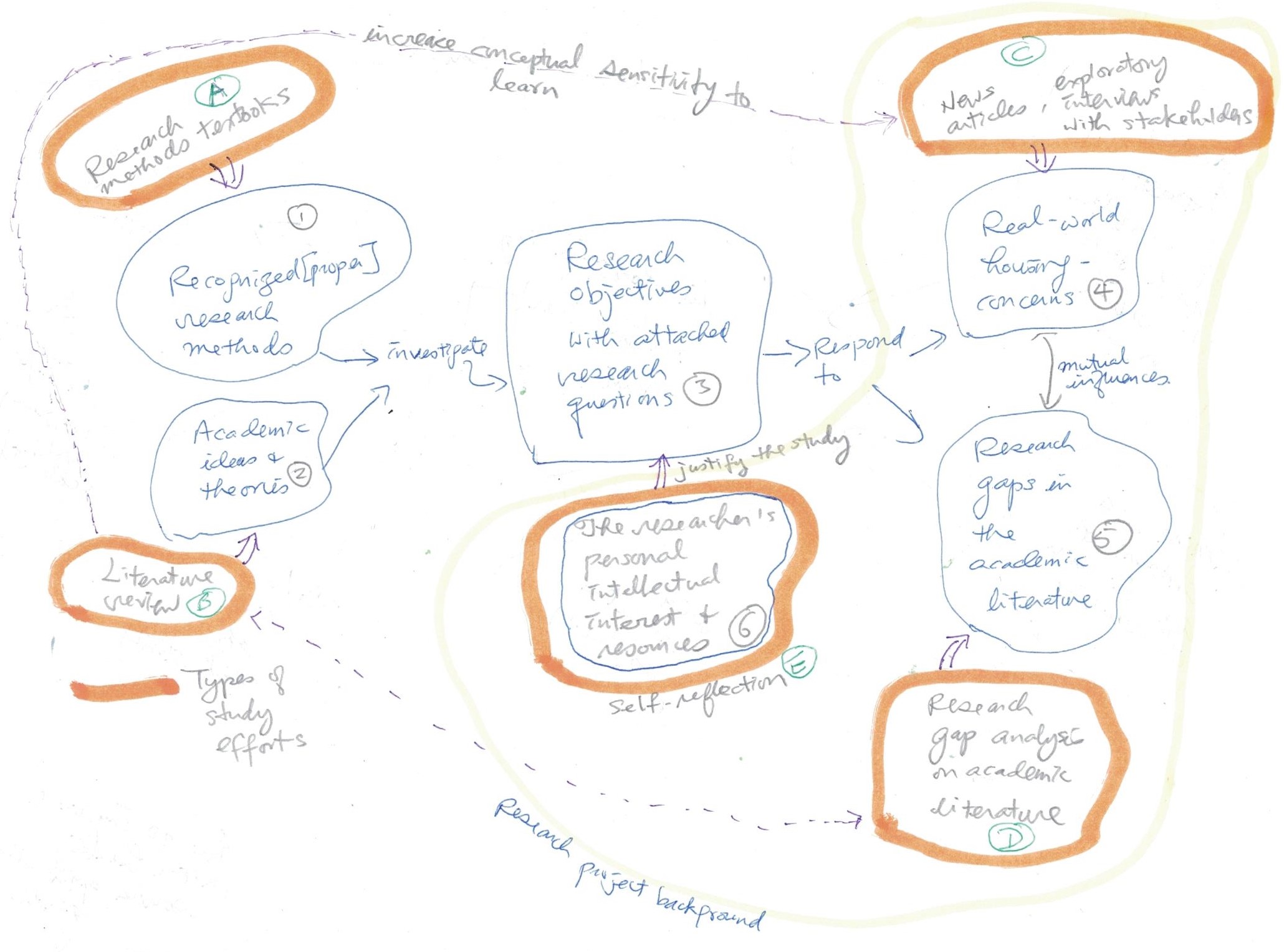
A holistic view on the emergence of research objectives and research questions: a note for housing studies (and business studies)

A holistic view on the emergence of research objectives and research questions: a note for housing studies (and also relevant for business studies).


Category I
Items A to E [types of study effort with regard to the study objects]
Item A: Research methods textbooks
Item C: News articles, exploratory interviews with stakeholders
Item D: Research gap analysis on academic literature
Item E: Self-reflection on the profile and positionality of the researcher.

Category II
Items 1 to 6 [Study objects]
Item 1: Recognized [proper] research methods
Item 2: Academic ideas and theories
Item 4: Real-world housing-concerns
Item 5: Research gaps in the academic literature
Item 6: The researcher's personal intellectual interest and resources

Category III
Linkage from Item B [literature review] (also Item A [Research methods knowledge]) to Item 4 [Real-world housing-concerns].


Case for class discussion (on a homelessness case); now consider the method of sociological imagination to come up with a few more concrete housing concerns.


Notice to my MBA students: If you replace Item 4 [real-world housing concerns] with Item 4 [real-world management concerns], the the holistic view presented in this note becomes a relevant study material for your Research Methods study.