Thursday, 13 August 2020

ALRA diagramming for housing dissertation project: an illustration

 Agile Literature Review Approach (ALRA) diagramming for housing dissertation project: an illustration:


An illustration of a theoretical framework level 0


An illustration of a theoretical framework level 1c [simplified]


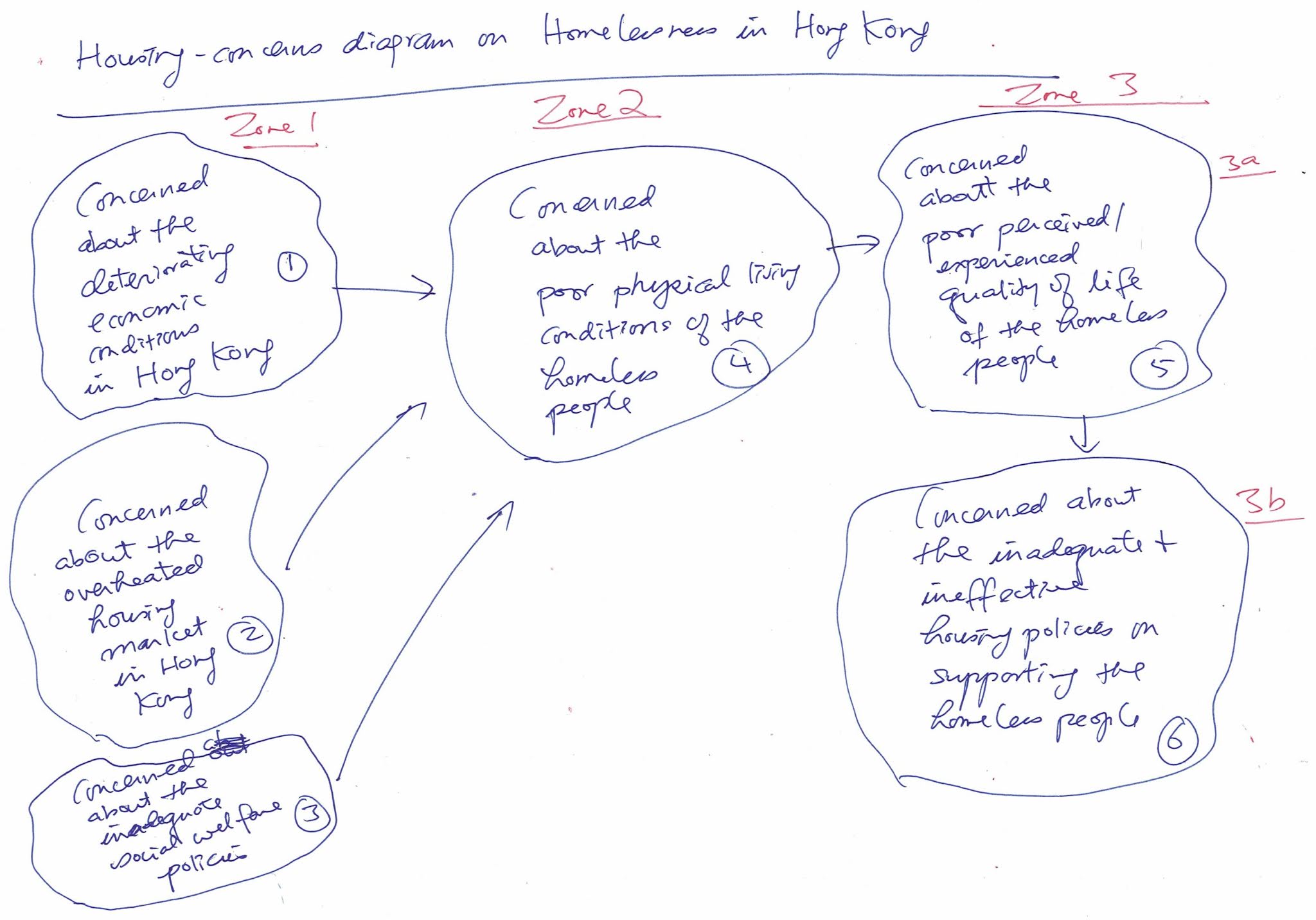
There is a need to produce a housing-concerns diagram so as to derive the theoretical frameworks as shown above. It could be something likes this, roughly:


It is also useful to group the components above into 3 zones:

Zone 1: environmental drivers

Zone 2: Housing-theme profile

Zone 3: Outcomes/ solutions related.


Finally, try to choose two to three items from the theoretical framework for your project core-focus domain. This is illustrated as follows:


Note that with this theoretical framework, the dissertation student can also formulate the the dissertation project title based on the components in the core-focus domain. At the same time, the dissertation's primary objectives are also clear:

1. to evaluate the physical conditions of homelessness in Hong Kong

2. to evaluate the psychological and subjective conditions of homelessness in Hong Kong


Other associated secondary objectives are:

I. Environmental drivers-related:

3. to evaluate how the economic trends influence negatively the homelessness situation in Hong Kong

4. to evaluate the impacts of the present HK housing policies on HK homelessness situation.


II. Outcomes/ solutions-related:

5. to evaluate the quality of life of the homeless people in Hong Kong

6. to evaluate the economic impacts of homelessness in Hong Kong

7. to evaluate the effectiveness of the existing and new housing policies on addressing the HK homelessness problem.


Tuesday, 28 July 2020

Innovation entrepreneurship and technology transfer assignment guidance 2020

Innovation entrepreneurship and technology transfer assignment guidance 2020 (additional)


Related to option 1
For your guidance, it will consist of: 
a) An introduction in which you introduce the theme that you are investigating, clearly emphasising its importance. 
b) A detailed methodology of the analytical approach you are taking, demonstrating a critical understanding of managing innovation and technology transfer theme. 
c) A section on your findings includes a critical evaluation, detailing the theme selected its implications and company examples. 
d) Conclusions and commercially viable solutions. 
e) Throughout the report, you must integrate theory with practice, critically evaluating your findings. 
f) All sources must be cited correctly in accordance with the Harvard system of referencing. 

Note 1

Note 2


Related to option 2
Secure a live organisation, to manage an innovation project and produce a reflective log.

For your guidance, it will consist of: 
a) An introduction in which you introduce the theme that you are investigating, clearly emphasising its importance both academically and commercially. 
b) A detailed methodology of the analytical approach you are taking. c) A reflective commentary documenting the challenge identified within the project and clearly evidenced with academic underpinning throughout. 
d) Personal reflections and commercially viable solutions to overcome the identified challenge. 
e) All sources must be cited correctly in accordance with the Harvard system of referencing.

Videos on reflective practices

Photo 1


Option 2. Secure a live organisation, to manage an innovation project and produce a reflective log. Word Count 6000 Words.

The reflective log, excluding appendices, should be 3000 words in length. 


************
In week 3 of the module you will submit a formative proposal of 300-400 words detailing: 
 Your choice of organisation or theme for investigation, and your proposed Managing the People Issues 
 How you will address each learning outcome You will receive formative feedback to guide you in line with the module aims. 

Send proposal direct to lecturer via email for comments (josephho33@gmail.com).

Tuesday, 7 July 2020

Research an innovation and technology transfer theme: assignment option 1 2020


Research an innovation and technology transfer theme from the module scheme of work and produce an individual academic report with illustrative examples. Word Count 3000 Words Option 1 is a research based assessment in which students must familiarise themselves (i.e. reading and reflecting on current journal articles) with a current theme from the module scheme of work. Student will then be required to write an academic report in the form of a journal paper, with the Dysan case as one of the illustrative case examples. The submitted paper must critically debate a current theme and be supported with illustrative examples, notably the Dysan’s case [re: footnote 1]. 

In week three of the programme you will be required to submit a formative proposal of 300-400 words detailing:  

1.      Your proposed managing innovation and technology transfer theme
2.      How you will address each learning outcome
3.      You will receive formative feedback to guide you in line with the module aims.
***** pls send your proposal direct to me by email (josephho33@gmail.com) for proposal comments. There is no formal submission of proposals onto canvas for assessment in this case.

4.      Guidance:  The academic report in the form of a journal paper, excluding appendices, should be 3000 words in length.

5.      For your guidance, it will consist of:

6.      a) An introduction in which you introduce the theme that you are investigating, clearly emphasising its importance.
b) A detailed methodology of the analytical approach you are taking, demonstrating a critical understanding of managing innovation and technology transfer theme.
 c) A section on your findings includes a critical evaluation, detailing the theme selected its implications and company examples, notably the Dysan’s case [re: footnote 1].
d) Conclusions and commercially viable solutions.
e) Throughout the report, you must integrate theory with practice, critically evaluating your findings.
f) All sources must be cited correctly in accordance with the Harvard system of referencing.

Option 1 is intended to give you an opportunity to show that you are capable of applying your knowledge of managing innovation and technology transfer with illustrative case examples, not only in describing the issue faced by the commercial sector, but also in explaining it and justifying your proposed actions for improvement.

Diagram 1:


Diagram 2


**********************

Knowledge 
K1 Critically analyse the management of innovation and technology transfer as a core business process.
K2 Critically evaluate the choices and challenges in building and managing an innovative organisation.
K3 Reflect upon and critically evaluate the key attributes in capturing learning from Innovation and technology transfer.

Skills 
S1 Demonstrate an ability to critically appraise theories of managing innovation and technology transfer in the 21st century.
S2 Evaluate the assessment of viable concepts, models and techniques in order to identify ease of transmission for the adoption and/or application of managing innovation and technology transfer.


e-resources:
Cognitive mapping on open innovation
Cognitive mapping on technology transfer

Thursday, 2 July 2020

Developing, Leading and Managing Competence Portfolio for MBA project pgbm161


TNE MBA Project Guide PGBM161 (30% of the project marks)

This will be a portfolio of critical self-reflection supported by evidence and will take the form of a critical reflection upon the development of skills and competences derived from the experience of undertaking the programme of study, the added value activities and the final project. This element of the assessment will be approximately 2,500 words (for guidance only).

**** This word count of 2,500 words on "Developing, leading and managing competence portfolio" is not included in the final dissertation report word count of 15,000 words. They are two separate documents: 
(i) Developing, leading and managing competence portfolio": 2,500 words, and 
(ii) Final dissertation report: 15,000 words.


Details:

Developing, Leading and Managing Competence Portfolio This element carries a weighting of 30% of the overall mark. The Portfolio will be approximately 2500 words (for guidance only). The formal teaching will be practice-based workshops covering critical skills, research practice skills and employability which will support the portfolio element of the assessment to enable the student to demonstrate personal development and mastery of postgraduate skills ...


The portfolio will encompass an evidence-based approach to experiential learning opportunities embedded or available to students during the course of the programme. The overarching style will be critical self-reflection on the part of the student to enable them to build a portfolio which evidences their personal development. The Portfolio will also include evidence of critical self-reflection on personal and organisational learning as a result of undertaking the project and how that learning relates to the MBA programme as a whole.


A suggested structure of the essay:

1. Introduction. [about 60 words]
2. A learning reflection on the process experience of (A) the main project phases, notably, on (i) proposal formulation, (ii) literature review,  (iii) research design, (iv) findings gathering and analysis, (v) and recommendation formulation, and (B) the whole MBA programme course, subject by subject. [Part A: 1,080 words; Part B: 600 words]
3. A learning reflection on the consequential dissertation project/ whole  MBA programme course experience with regard to: (i) personal skill development/ career plan/ employability/ work-life balance impacts and (ii) organizational learning impacts. [Part i: 400 words; Part ii: 200 words]
4. Concluding remarks [160 words] 

*** For Parts 2 and 3, it is useful to provide some examples of learning episodes for illustration purpose and as "evidences" to support your reflective reasoning. 


*** For Part 3, some knowledge about the value of MBA education would be useful for reflection purpose, e.g. the future of the MBA and what is the future of MBA education. (also take a look at the video on Sunderland MBA).

Some useful e-readings

  1. Gibb's reflective cycle (video) [also an example of a report in terms of Gibb's reflective cycle].
  2. Kolb's experiential learning cycle (video)
  3. How to write a reflection essay (video)
  4. A briefing on learning portfolio, including e-portfolio (video). [another brief video is "why build a portfolio"' another video is on portfolio assessment].

Exhibit 1


Exhibit 2


*** Students are recommended to watch the above 4 videos before starting to write up the "Developing, leading and managing competence portfolio".


The following set of questions serves as a tool for reflective thinking:


Source: Bourner, T. 2003. "Assessing reflective learning" Education + Training, Vol. 45 (5), pp. 267-272, Emerald.


*** Since students are required to produce the "Developing, leading and managing competence portfolio" report, there is no need to write a "personal development" section in the dissertation report. The "Developing, leading and managing competence portfolio", being a separate document, replaces the "personal development" section of the dissertation report.

Doc 1: dissertation report
Now refer to the table of content template.

In this case, it is as follows (without Chapter 6):

Dissertation project title
Executive summary
Acknowledgement
Table of contents
List of figures and tables


Chapter 1: Introduction

Chapter 2: Literature review

Chapter 3: Research methods

Chapter 4: Findings and analysis

Chapter 5: Conclusions and recommendations

References
Appendix

Doc 2: Learning portfolio

*****

Finally, I recommend students to submit both the portfolio document and the final dissertation report at the same time so that the first marker and the examiner can do the whole job of report assessment on the university canvas.


References

1. Barriers to constructing experiential learning claims through reflective narratives: Student’s experiences. (Emerald)


Management-concerns diagram and theoretical framework level-0 at the industry level: a note

Management-concerns diagram and theoretical framework level-0 at the industry level: a note


***  Also refer to the agile literature review approach group to learn more about the ALRA thinking.

*** An industry here could also be a supply chain for a particular business sector, or a supply chain for a particular company as a focal organization under review, in this case.

Reference

Thursday, 25 June 2020

Business sector research for dissertation projects of PGBM161


Business sector research for dissertation projects of PGBM161
(re: module guide of PGBM161)


The research proposal will review your ability to achieve the following:

1. To identify a suitable strategic project for an organisation or sector and select a project that could if designed and implemented well be of strategic importance (not just operational) with a significant impact on results. For example, in reducing costs opening up new markets, introducing a new product or service, enhancing skills capability and knowledge, improving quality and or service, redesigning internal business operations etc. This is not an exhaustive list.

2. To define and locate the main academic ideas, theories and business practices evolving from these ideas in a critical literature review. This should cover the main subject area (e.g. service quality) and thereafter briefly review the main ideas: the main ideas and business practices and key areas of possible contention where there are alternative issues either in the nature of the idea or methods of implementation etc. This review should aim to locate some of the primary sources/authors you believe it necessary to review. This will not at this stage be exhaustive as your study is at an early stage in its development.

3. From this you will be required to specify the objectives of the dissertation as clearly as possible. These should be presented as outcomes to be achieved for the dissertation in terms of what business improvement or change the dissertation seeks to implement. The reason and rationale in terms of the sector/ organisation need to be covered under 1 above. You should avoid hypotheses and statements that reflect ‘what’ you are going to do in terms of say investigation or information review. These are not objectives.

4. Finally you will be asked to identify some appropriate ways that you could investigate: - The subject you have selected to ensure that the objectives are met and that information is collected from both primary and secondary sources to ensure that the study can be completed in appropriate depth to achieve masters learning outcomes. These methods should aim to reflect the real methods that can actually be introduced rather than the theory.


e-resources
FB group on academic literature on business sector study

Thursday, 18 June 2020

Diagramming technique for housing dissertation proposal formulation: a note

Diagramming technique for housing dissertation proposal formulation: a note

Step 1: using cognitive mapping technique to produce a housing-concern diagram. An example is as follows:


Step 2: convert housing-concerns into high-level research tasks and low-level research tasks:

An example:

Concerned about current situation on the homeless status of the HK youth. (re: the housing-concerns diagram in step 1)


Converted into:


** To evaluate the current situation on the homeless status of the HK youth.    {a high-level research task}


** To learn how the homeless youth perceive their homeless status via semi-structured interview. {a low-level research task}