Monday, 2 January 2012

On low cost product innovation

Betterncourt and Bettencourt (2011) is an article offering practical advice on low cost product innovation. As I see it, this kind of advice on product innovation is especially valuable for companies with tight budgets on R&D and for companies aiming for business growth in market segments with price-sensitive customers. Briefly, some of their suggestions that I figure out from reading their article are as follows:

  1. Review previously rejected product concepts in view of the present market situation, e.g. changed customer needs, to spot business opportunties
  2. Find out unaware-of innovations wrapped up in existing product bundles to develop new products
  3. Re-design products with fewer features as "good enough" products to target new market segments
  4. Find out possibilities of enhanced customer value via bundling of complementary products

These are then ideas of low-cost product innovations noted briefly from Bettencourt and Bettencourt (2011). You need to refer to their article for a full account of their ideas.


Reference
Bettencourt, L.A. and Bettencourt, S.L. (2011) "Innovating on the cheap" Harvard Business Review June, pp. 88-94.

Examining cloud computing from the top management perspective

McAfee (2011) examines the major issues of adopting cloud computing from the top management perspective. It is a good reading on cloud computing for business management students. The main value, from my perspective, is his coverage on the following 3 topics as related to cloud computing:

  1. The benefits of adopting cloud computing in enterprises: e.g. productivity improvement; more collaboration in business running; access to a broader range of software as services, including data mining.
  2. The problems and concerns of adopting cloud computing:  legacy IT  problem; uncertainty on cost; uncertainty of software reliability; IT security concerns; legal uncertainty arising from cloud computing usage.
  3. The appropriate steps for adopting cloud computing in enterprises: 4 guidelines are offered by McAffee. The main idea is, in brief, to adopt a gradual and exploratory approach of cloud computing adoption, plus collaboration with enterprises' software vendors in the process.
You need to refer to McAfee's article to learn the detailed line of reasoning on the ideas briefly noted above.


Reference
MdAffee, A. (2011) "What every CEO needs to know about the Cloud" Harvard Business Revew November, pp. 124-132.

Cope with business complexity

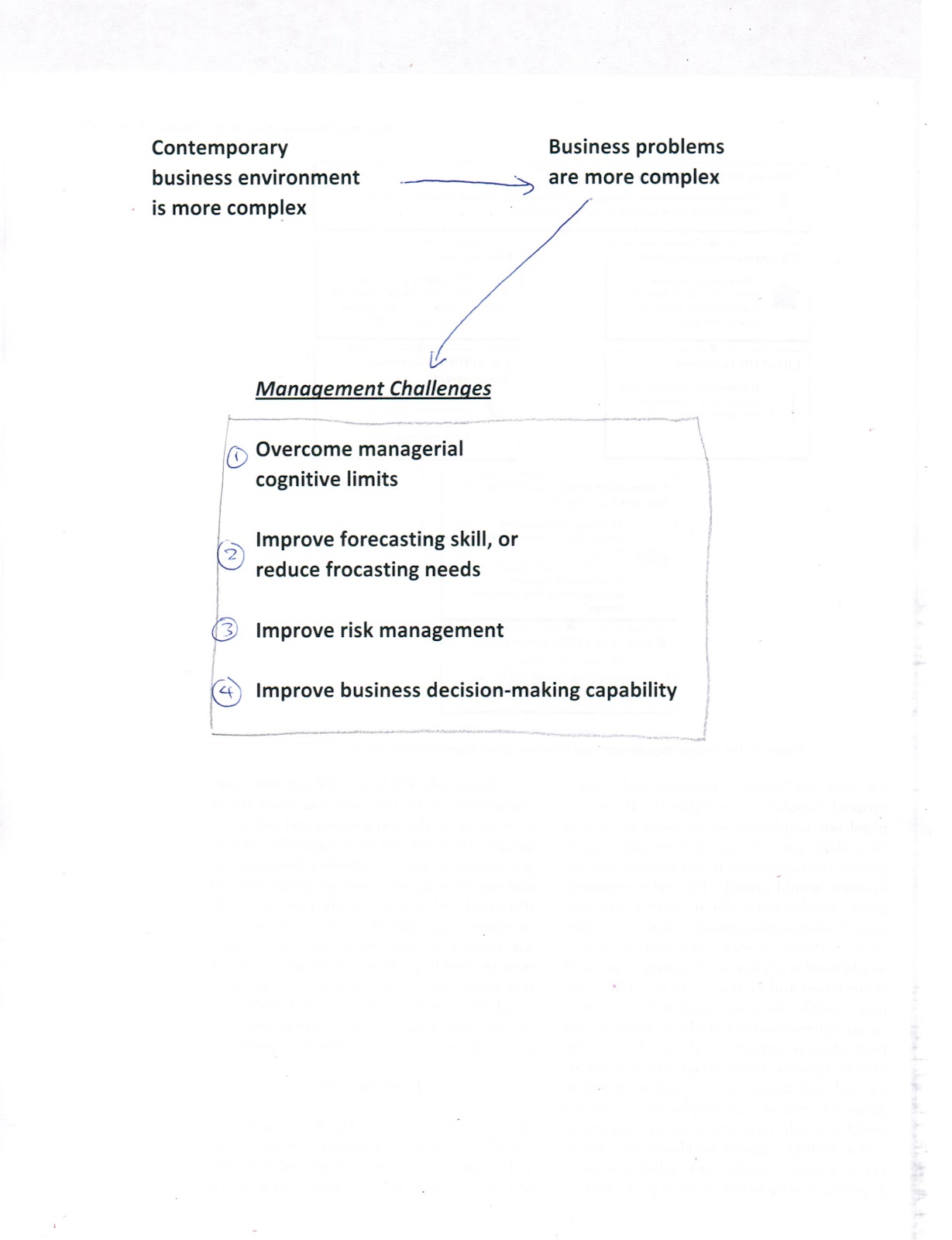
Sargut and McGrath (2011) is an article on how to cope with business complexity in the contemporary business environment. This topic has been much investigated in the business and academic world, notably from the systems community. Sargut and McGrath's theme is depicted in the following diagram from me:


You need to refer to their article  for an elaboration of their line of reasoning. I tend to think that the discussion need to cover normative and organizational structural considerations to cope with complexity. At the same time, I can understand that the topic of complexity management cannot be dealth with easily in one article. Overall, the article is an updated reading with good practical advices and its ideas are accessible to practising managers. The article can be used for class discussion when the notion of system complexity is taught.


Reference
Sargut, G. and McGrath, R.G. (2011) "Learning to live with complexity" Harvard Business Review September, pp. 68-76.

Operational responses to the digital social media-based environment

From what I can figure out, Bernoff and Schadler (2010) mainly examines the topic of how to empower customer-facing operational staff to respond more effectively to empowered customers in the contemporary digital sociam media environment. I depict their ideas in the following diagram based on my reading of their article:


Their rationale can be interpreted  as a form of variety engineering in Management Cybernetics. You need to refer to their article to learn the full line of reasoning of their article theme.


Reference
Bernoff, J. and Schadler, T. (2010) "Empowered" Harvard Business Review July-August, pp. 94-101.

On strategies to learn from failures - review note

The main ideas from Edmondson (2011) on strategies to learn from failures appear to be related in the following ways that make up a coherent theme:


There are 4 main iniatiatives identified by me in Edmondson (2011) that promote failure learning in organizations. In the discussion, two new concepts are formulated, namely, (1) blameworthy failures vs praiseworthy faillures, and (2) psychologically safe environment. Overall, a very useful contribution to the literature of Failure study in Management.


Reference
Edmondson, A.C. (2011) "Strategies for Learning From Failure", Harvard Business Review April, pp. 48-55.

Sunday, 1 January 2012

Self assessment of English language competence

I have come across an IELTS English language competence assessement scheme as follows:


As a university degree student, if your competence is lower than level 6 in terms of the competence scheme above, you should review your learning style and reading habit to see how to improve your competence level to level 6 or above. Patience, focus and persistence are required. Improving English language competence, on the other hand, need not be stressful, boring nor expensive. Most the English language skill you have already learned in secondary school Form 3-5.

Try to do more reading of academic and professional journals. Try to watch TV programmes in English. You should also find time to do some revision of your English grammar by reading some references on English  grammar if your English language competence level is very low. These days, there are good quality English grammar references that you can easily find from public libraries and bookshops.

Hot management topics for 2010-2011

By briefly reviewing the articles published in Harvard Business Review (HBR) from 2010 to 2011, I highhglight the main hot management topics and exact key phrases in the field of management. These key concepts provide useful clues of what keep senior managers awake at night. I believe they provide useful ideas for management research, including final year dissertation proposal formulations for business students. The following table groups the key HBR concepts by major management themes (there are 8 themes noted by me in this exercise). The items provided in the table are not exhaustive in this case.


Human resource management/ general managementManagerial style/ LeadershipProduct developmentCorporate social responsibilityGlobal Business ManagementChange managementStrategic Management/ MarketingIT Management
CEO successionHorrible bossesBreakthrough productsWork with green activistsCosmopolitcan corporationShake-up of businesssGreat repeatable business modelCloud computing
Effective organizationsWise leadersGreen product developmentSocial strategiesThe China rulesInnovation warsBusiness model of organized crimeIT project risks
ProductivityAdaptive leadershipco-creative enterpriseHow to conquer new marketsThe execution trapMystery shopping
Social media roleLeadership lessons from militaryEmerging market giantsEntrepreneurial revolutionGrowth markets
How to fix mistakesBosses as human shieldsGlobal acquisition from PRC enterprisesEntrepreneurial opportunitiesEmpowered customers with social media
Productivity paradoxMistakes leaders makeChina's bid for technology dominanceReinvent business modelStrategy execution
Decision-driven organizationsCollaborative leadersBottom of the pyramidInnovation on front linesStrategy stress test
Promotion: men vs womenProfessional boardsLearn from failuresSocial media strategy
Collaborative enterpriseUnleash innovation from leadersBuild culture of trust and innovationPlace corporate bets
Evolution of modern managementA culture of experimentationHow to fix capitalism
Embrace complexityWhy good ideas dieMake financial markets work for consumers
Creatively managed companiesNew rules of branding with social media
Collective ambitionMake great strategic decisions
Succession not as a horse raceCompete against "free"
Lean principles for knowledge worksNew M&A playbook
Reinvent supply chain