Monday, 12 December 2022

Dissertation project background: a note for proposal preparation (housing studies)

Dissertation project background: a note for proposal preparation (housing studies):

A. (Real-world) housing-concerns related [housing-concerns contextualization] {especially relevant to housing-concerns-oriented project type}

1. when?

2. where?

3. who?

4. how serious? how complicated? how urgent?


B. Academic-related [academic-oriented contextualization] {especially relevant to academic-oriented project type}

1. any academic research gaps?

2. knowledge gap? controversy of topics and issues? a new academic topic at the exploratory stage?


C. Personal-consideration of the researcher [personal-oriented contextualization]

1. arising from personal lived experience

2. interested in the topic as related to personal social network

3. arising from personal academic interest/ intellectual curiosity

4. arising from personal professional/ career interest.


Dissertation proposal elements for Housing Studies: a list

Dissertation proposal elements for Housing Studies: a list

Proposal element 1: project title

Proposal element 2: project background

Proposal element 3: project (housing-) concerns

Proposal element 4: research objectives

Proposal element 5: preliminary literature review findings

Proposal element 6: preliminary research design and research methods

Proposal element 7: project plan

Proposal element 8: preliminary reference list

Proposal element 9: word count figure of the proposal

Proposal element 10: proposal submission date


** the agile literature review approach, notably its diagrams, is very useful to help addressing these proposal elements.


Some associated evaluation considerations:

1. How is the proposal informed by the agile literature review approach?

2. What are the quality criteria of dissertation proposal?

Friday, 9 December 2022

The legitimate reasons why items in a housing-concerns diagram are fewer than that in the theoretical framework (ALRA)

 The legitimate reasons why items in a housing-concerns diagram are fewer than that in the theoretical framework (ALRA) in housing studies dissertation works:


In the agile literature review approach (ALRA), the housing-concerns diagram takes stock of a set of related housing concerns items as a co-created output of the researcher and a few stakeholders in a case study. These housing concerns are the ones to be responded to intellectually as depicted in the corresponding theoretical framework (starting from level-0). The question is, what can be the legitimate reasons that the corresponding theoretical framework has fewer items that that of the housing-concerns diagram. Here, I offer two legitimate reasons


Reason 1. If two housing-concerns items belong to the same housing studies topic (e.g. deteriorating economic trends affecting the housing market), then the two housing-concerns items can be consolidated (maybe also with the expansionism rationale) to become one theoretical framework item. 

An example:

Housing-concern 1 [hc1]: concerned about the impact of increasing interest rate on the housing affordability situation facing the middle-class in Hong Kong

Housing-concern 2 [hc2]: concerned about the impact of increasing unemployment rate on the housing affordability situation facing the middle-class in Hong Kong

A corresponding consolidated theoretical framework item (item 2): to evaluate the worsening economic trend on the housing affordability situation facing the middle-class in Hong Kong. [note: in this example, the economic trend covers interest rate and unemployment rate trends, among others].


Reason 2: the housing concerns item (a clarifying housing-concerns item [chci]) appears in the housing-concerns diagram mainly to further clarify the nature of another significant housing-concerns item (a significant housing-concerns item [shci]). In this case the chci itself will not be directly transformed into a theoretical framework item in the theoretical framework.

An example:

Housing concern 1[hc1] [chci]: concerned about the impact of the weakening HKD on the interest rate movement in Hong Kong

Housing concern 2 [hc2] [shci]: concerned about the impact of the interest rate movement on the housing affordability situation facing the middle-class in Hong Kong.


In this case, HC1 [a chci] is not to be considered to produce a corresponding theoretical framework item for the theoretical framework level-0. HC1 mainly serves to  clarify the nature of HC2 in the housing-concerns diagram.


The legitimate reasons why items in a management-concerns diagram are fewer than that in the theoretical framework (ALRA)

The legitimate reasons why items in a management-concerns diagram are fewer than that in the theoretical framework (ALRA) in MBA dissertation works:


In the agile literature review approach (ALRA), the management-concerns diagram takes stock of a set of related management concerns items as a co-created output of the researcher and a few stakeholders in a case study. These management concerns are the ones to be responded to intellectually as depicted in the corresponding theoretical framework (starting from level-0). The question is, what can be the legitimate reasons that the corresponding theoretical framework has fewer items that that of the management-concerns diagram. Here, I offer two legitimate reasons


Reason 1. If two management-concerns items belong to the same management topic (e.g. challenges arising from the deteriorating supply chain landscape), then the two management-concerns items can be consolidated (maybe also with the expansionism rationale) to become one theoretical framework item. 

Reason 2: the management-concerns item (a clarifying management-concerns item [cmci]) appears in the management-concerns diagram mainly to further clarify the nature of another significant management-concerns item (a significant management-concerns item [smci]). In this case the cmci itself will not be directly transformed into a theoretical framework item in the theoretical framework.

Thursday, 8 December 2022

A note on the core-focus-domain in the agile literature review approach (ALRA) diagrams for housing studies

 A note on the core-focus-domain in the agile literature review approach (ALRA) diagrams for housing studies.


Core-focus-domain (CFD) is required to be indicated in the theoretical framework level-0; some students also indicates CFD early in the housing-concerns diagram.

What CFD comprises are the main research objectives of a consulting-oriented dissertation project that employs the agile literature review approach. My recommendation is that at least 1  CFD item should be located in zone 2 (housing topic: nature and characteristics) of the ALRA diagrams. It is normally a good idea to have 1 CFD item in zone 2 so that the basic housing theme (e.g. homelessness, housing affordability, and home ownership) is clear and focused. Anyway, the number of CFD items should be 1 to 2, in order to offer a reasonably robust research focus for a dissertation project. Each CFD item should be populated with about 4 academic ideas (via the literature review effort) while a non-CFD item makes use of 1-2 academic ideas. As such a full-fledged two-direction literature review is mainly relevant to CFD items.

The implication of having a CFD is that about 50 to 60% of the literature review and research efforts should be spent on the CFD items. 

The non-CFD items are useful in that they provide a clear contextualization of the research project work and help in clarifying the nature of the CFD items.


Note: The advice provided in this note is primarily for housing students doing dissertation projects at the undergraduate degree level.


Wednesday, 7 December 2022

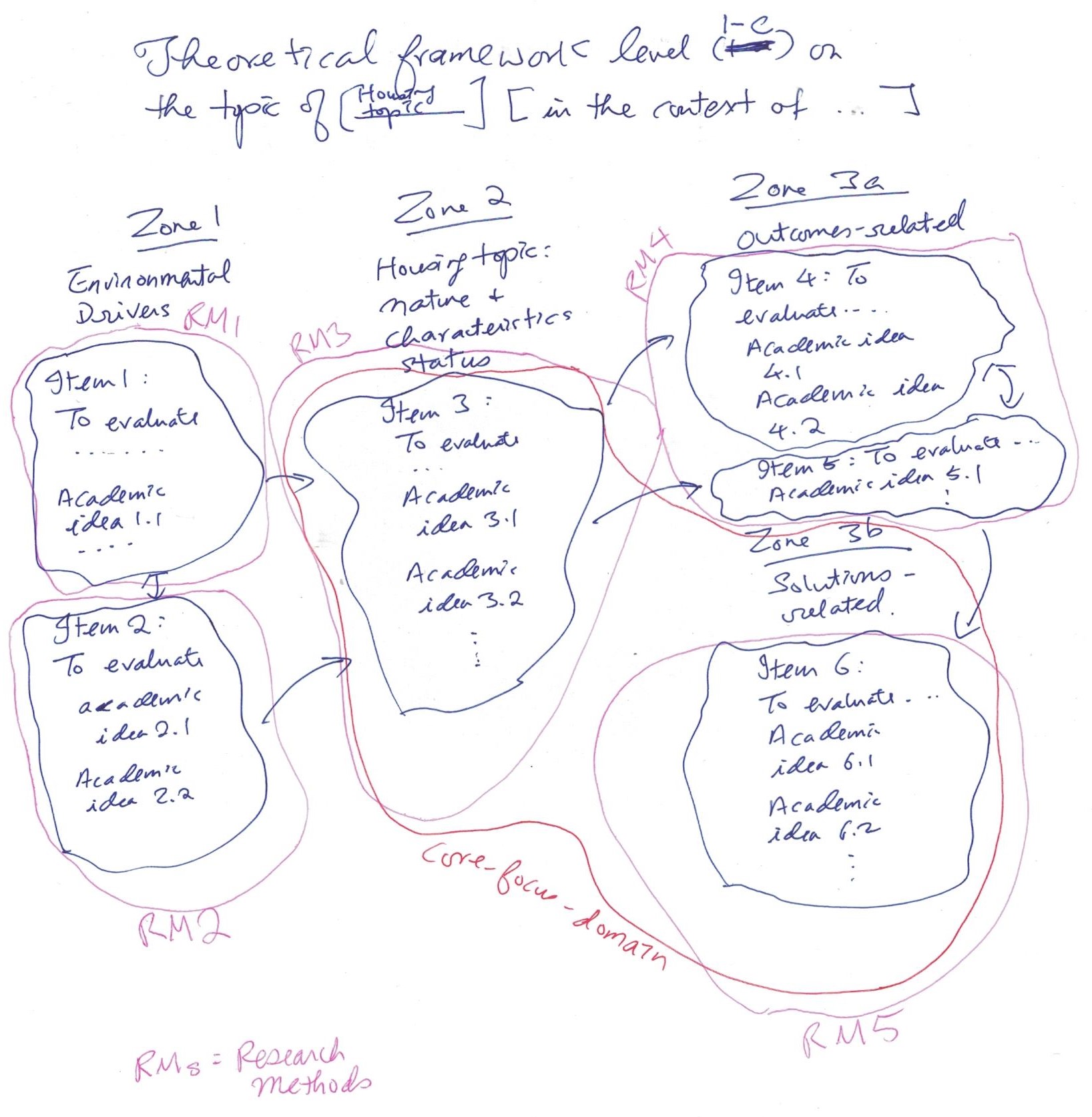
A note on the theoretical framework level-1c of the agile literature review approach for housing studies

 A note on the theoretical framework level-1c of the agile literature review approach  (ALRA) for housing studies.


The generic format of the theoretical framework level-1c of the agile literature review approach (ALRA) for housing studies is as follows:


Main points of clarification:

1. The theoretical framework of level-1c is constructed by mapping research methods onto the theoretical framework level-1a. (called research methods mapping).
2. It is possible that one research method, e., questionnaire survey, can cover more than 1 item (i.e. research objective) in the theoretical framework of level-1c. It is also possible that more than 1 research method are employed to study one item (research objective). 
3. Theoretical framework level-1c portrays a lot about the overall research design of a dissertation project (in housing studies in this case, but it does not reveal dissertation project task-dependencies of the dissertation project.


A note on the theoretical framework level-0 of the agile literature review approach for housing studies

 A note on the theoretical framework level-0 of the agile literature review approach (ALRA) for housing studies:


The generic format of theoretical framework level-0 of the agile literature review approach (ALRA) for housing studies is as follows:


Main points of clarification:
1. The theoretical framework level-0 is blueprint of doing literature review. It comprises all the high-level research tasks (also as research objectives) of a dissertation project (in housing studies in this case).
2a. These high-level research tasks (labelled as items in the diagram) are derived from the housing-concerns diagram.
2b. Number of items expected in each zone of the framework is:
Zone 1 (environmental drivers): 2-4 items
Zone 2 (housing topic: nature and characteristics): 1-2 items
Zone 3a (outcomes-related): 2-3 items
Zone 3b (solutions/ policies-related): 2-3 items

3. It is not mandatory that all the housing-concerns diagram items (labelled as housing concerns (HCs) in the housing-concerns diagram be converted into items in the theoretical framework level-0, because not all HCs need to be studied via literature review and research methods study. The simple and straightforward HCs could be skipped for the purpose of constructing the theoretical framework level-0.
4. Once the theoretical framework level-0 has been populated with academic ideas (as the literature review output), the theoretical framework level-0 becomes the theoretical framework level-1a.